
Why Repetition Changes Belief (And Motivation Doesn't)
Motivation fades. Repetition builds. Here's why consistent return to a single idea reshapes how you think.
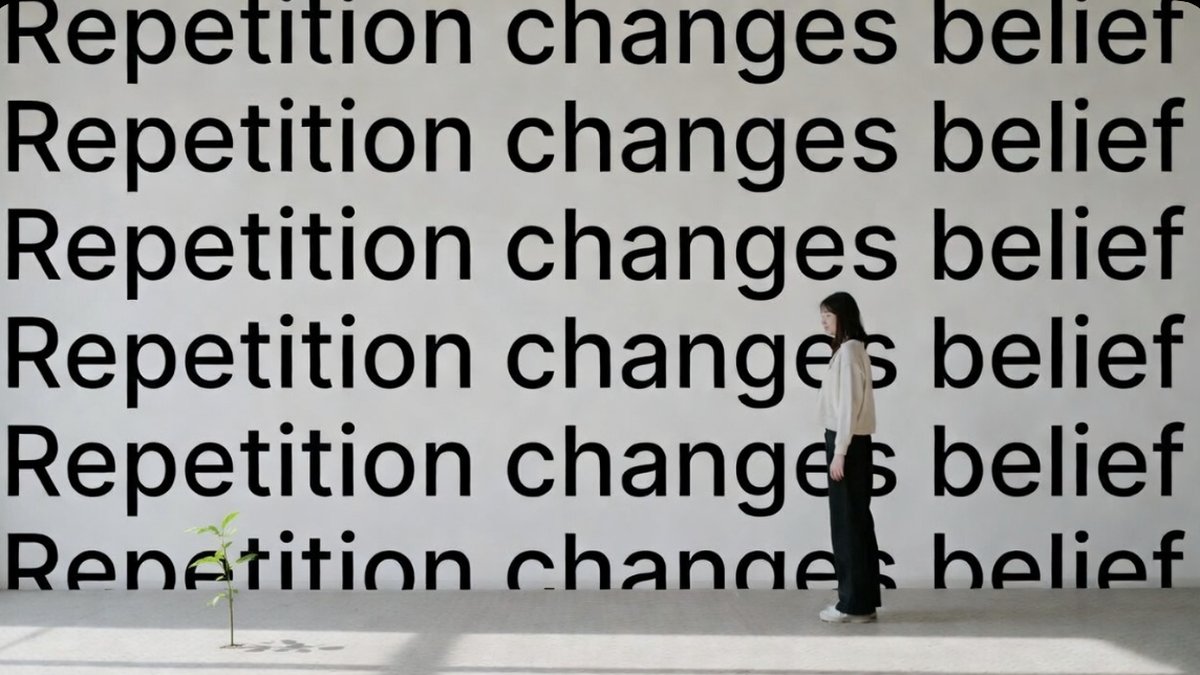
Motivation is unreliable. It spikes after an inspiring video, a good conversation, or a fresh start. Then it fades. By Wednesday, the enthusiasm from Monday feels distant.
Yet most personal development advice centres on finding more motivation. Get inspired. Stay pumped. Keep the energy high.
This approach fails because it misunderstands how beliefs actually form.
The Problem with Motivation
Motivation is an emotional state. Like all emotional states, it fluctuates based on sleep, stress, circumstances, and countless other factors outside your control.
Building lasting change on motivation is like building a house on sand. The foundation shifts constantly.
Consider how many times you've felt motivated to change something, only to find yourself back at the starting point weeks later. The motivation was real. The change didn't stick.
This isn't a character flaw. It's a misunderstanding of the mechanism.
How Beliefs Actually Form
Beliefs don't form through single moments of insight. They form through repeated exposure and reinforcement.
Think about beliefs you hold strongly. Most of them developed gradually, through countless small experiences and repetitions, not through one dramatic revelation.
The belief that you're good at something came from repeated experiences of competence. The belief that you struggle with something came from repeated experiences of difficulty. Neither arrived fully formed in a single moment.
Neuroscience supports this. Neural pathways strengthen through repeated activation. The phrase "neurons that fire together, wire together" captures this principle. A thought pattern that occurs once makes a faint impression. A thought pattern that occurs daily builds a well-worn path. As Stanford psychiatrist Dr. Jacob Towery notes, the brain is neuroplastic - "neural networks can continue to grow, change, and reorganize throughout the lifespan" - meaning new beliefs can be formed at any point through consistent repetition.
Repetition as the Core Mechanism
If beliefs form through repetition, then changing beliefs requires deliberate repetition of new patterns.
This is fundamentally different from motivation. Motivation asks: "How can I feel driven to change?" Repetition asks: "What thought pattern will I reinforce today?"
The repetition approach doesn't require feeling motivated. It requires showing up. Even when uninspired. Even when tired. Even when doubtful.
Consistency matters more than intensity. A small reinforcement repeated daily outperforms an intense burst of motivation that fades. Research published in Nature Reviews Neuroscience confirms that spaced repetition over time produces significantly more robust memory and belief formation than massed, intensive sessions.
Why Small Daily Reinforcement Works
Consider the difference between these two approaches:
Approach A: Feel deeply motivated, spend an hour journaling about your goals, experience a breakthrough, then gradually forget about it over the following weeks.
Approach B: Spend two minutes each morning returning to a single statement that captures what you want to believe. Repeat for weeks regardless of how you feel.
Approach A feels more significant in the moment. Approach B produces more lasting change.
The reason is simple: Approach B accumulates. Each small repetition adds to the previous one. Over time, the cumulative effect exceeds any single intense session.
This is the compound effect applied to belief. A 1% shift, repeated daily, transforms thinking over months.
The Role of Emotion
This doesn't mean emotion is irrelevant. Engaging genuinely with each repetition matters more than mechanical recitation.
But the emotion doesn't need to be motivation. It can be quiet attention. Simple presence. A moment of genuine connection with the words, even if you don't feel inspired.
The key is that you return. Day after day. Building the pathway through consistent use.
Practical Application
If you want to change a belief, stop waiting for motivation. Instead:
Choose one statement that represents the belief you want to hold. Make it specific enough to be meaningful, realistic enough to be believable.
Return to it daily. Not when you feel like it. Daily. Morning and evening if possible.
Repeat it deliberately. Not rushing through. Taking a moment to connect with the meaning.
Continue regardless of feeling. Some days it will feel powerful. Some days it will feel empty. Both days count equally toward building the pathway.
Trust the accumulation. Change happens gradually, then suddenly. The daily repetitions accumulate invisibly until the belief feels natural.
The Shift in Perspective
Moving from motivation-based to repetition-based change requires a perspective shift.
You stop asking: "How do I get motivated enough to change?" You start asking: "What will I repeat today?"
You stop waiting for the right feeling. You start showing up regardless of feeling.
You stop expecting dramatic breakthroughs. You start trusting gradual accumulation.
This is less exciting than motivation. It's also far more effective.
What This Means for Practice
Structured repetition tools exist because motivation doesn't work. The structure provides what motivation cannot: consistency.
When you commit to repeating a belief for seven days, morning and evening, you remove motivation from the equation. The structure carries you through days when motivation is absent.
By the end, you've reinforced the belief enough times that it begins to feel familiar. Familiar thoughts become natural thoughts. Natural thoughts become how you actually think.
That's not magic. That's the mechanism.
The Bottom Line
Motivation fades. Repetition accumulates.
If you want to change what you believe, stop chasing motivation and start building consistent return to the beliefs you want to hold.
Small daily reinforcement shapes how you think, which shapes how you respond, which shapes what you build.
Explore structured repetition in Muselii
A quiet daily practice for shaping the beliefs you want to live by.
Download Free